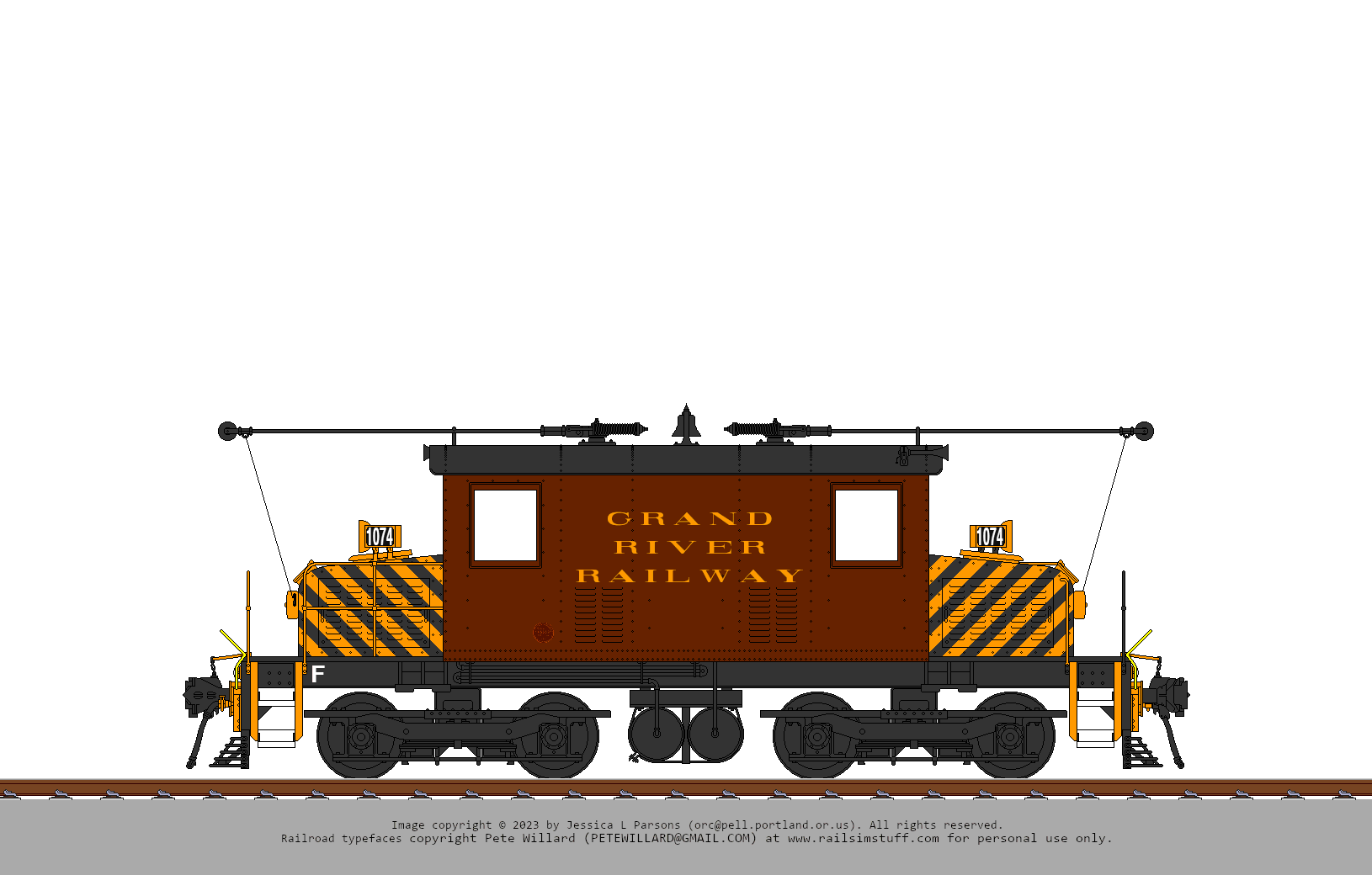
The original (Canadian Pacific subsidiary) Grand River Railway was absorbed into the CPR in the 1960s, leaving most of the trackage intact – some of the GRNR around Kitchener was abandoned in favour of CNR trackage rights, and the last half dozen blocks at the north end (including three blocks of side-of-the-street trackage) went out of use in the 1980s, only being kept at the request of the Ontario Radial Railway Company, which had purchased the Lake Erie & Northern and was negotiating to purchase or lease the GRNR.
These negotiations took A While, but by the mid 1990s the CPR had gone heavily into route rationalization and decided that the GRNR hasn’t bringing in enough traffic to keep operating, so finally leased it, and the GRNR name, to the ORRC.
It was re-electrified, of course; the ORRC had a corporate parent that was very generous about underwriting electrification, and preferred to operate the ORRC as a system of radials.
The northern end of the line was trimmed back when the municipality of Waterloo started work on their ION rapid transit system (the ORRC talked the engineers into electrifying ION at 1500vdc as well as getting freight rights along the new line replacing the trimmed back segment), but it continued to operate without incident until 2025, when CPKC and the Parsons Vale Lines agreed to merge.
When the systems merged, this railway was transferred to the ORRC, and then some weird magic happened;
Around the year 2000, ION had not only purchased the northern end of the GRNR, but also CNR’s Waterloo spur for of their system. And unlike the GRNR’s north end, there were still shippers along the Waterloo spur, so after the ION track crews had finished their work bids were requested for a freight operator.
The Ontario Southwestern won that bid, and had been operating diesels along the branch, but after the United Railway Trust merger they subcontracted it out to the ORRC, which was connected to it via those trackage rights along Caroline St South.
ION was not really surprised when the GRNR said they were going to start exercising those trackage rights to connect the two segments together, and, anticipating the followup request, preemptively allowed the GRNR to run motors under the wire.
The very northern end of the Waterloo Spur had been connected to the OSW’s old G&G line, so stayed diesel (and serviced by the regular OSW pickup freight (there’s v-e-r-y little freight between Guelph & Goderich, but there’s enough for a twice a week freight and switching Elmira is not really out of the way) but the GRNR electrified from the north end of the ION trackage to St. Jacobs, where there were two businesses and the Waterloo Central Railway’s main restoration shops.
The ORRC had assigned the three TSR Baldwin steeplecabs to the southern segment of the GRNR when they first electrified it, but after the expansion north to St. Jacobs refitted them with pantographs to operate under ION wires.